
Your Consultation
Every LASIK practice uses a laser. What separates outcomes is everything that happens before anyone touches it: how carefully your eyes are measured, who interprets those measurements, and who builds your treatment plan.
Here's exactly what happens when you come in, and why each step exists.
Schedule a ConsultationYour Evaluation, Step by Step

A conversation about your eyes and your goals
Before any testing, we talk. Your vision goals, your daily life, your health history, your worries. Vision correction is not one-size-fits-all, and the right recommendation starts with understanding what you actually need your eyes to do.

preparation before imaging
Before we photograph and map your eyes, depending on your unique eye anatomy, we may have you sit for a few minutes wearing special focus-relaxing lenses. This step is rare in LASIK care, and it matters more than almost anything else we do.
Here's why: the muscles inside your eye that control focus don't fully relax on command. If your eye is measured while those muscles are still working, the measurements capture a slightly distorted version of your eye. The preparation means the maps we capture show your eye as it truly is.
This protocol was developed in our practice, and it's now being used by surgeons elsewhere.

Imaging, repeated until it's right
We capture detailed maps of your cornea using SightMap diagnostic imaging, the technology behind personalized WaveLight Plus treatment. And we don't settle for the first capture. Imaging is repeated as many times as needed until the measurements are ideal. Minutes of extra care here shape everything that follows.

A complete eye examination
A thorough examination of your eye health, from the surface of the cornea to the retina. We're not just asking "can this patient have LASIK?" We're asking "what is the healthiest long-term choice for these eyes?"
An honest recommendation
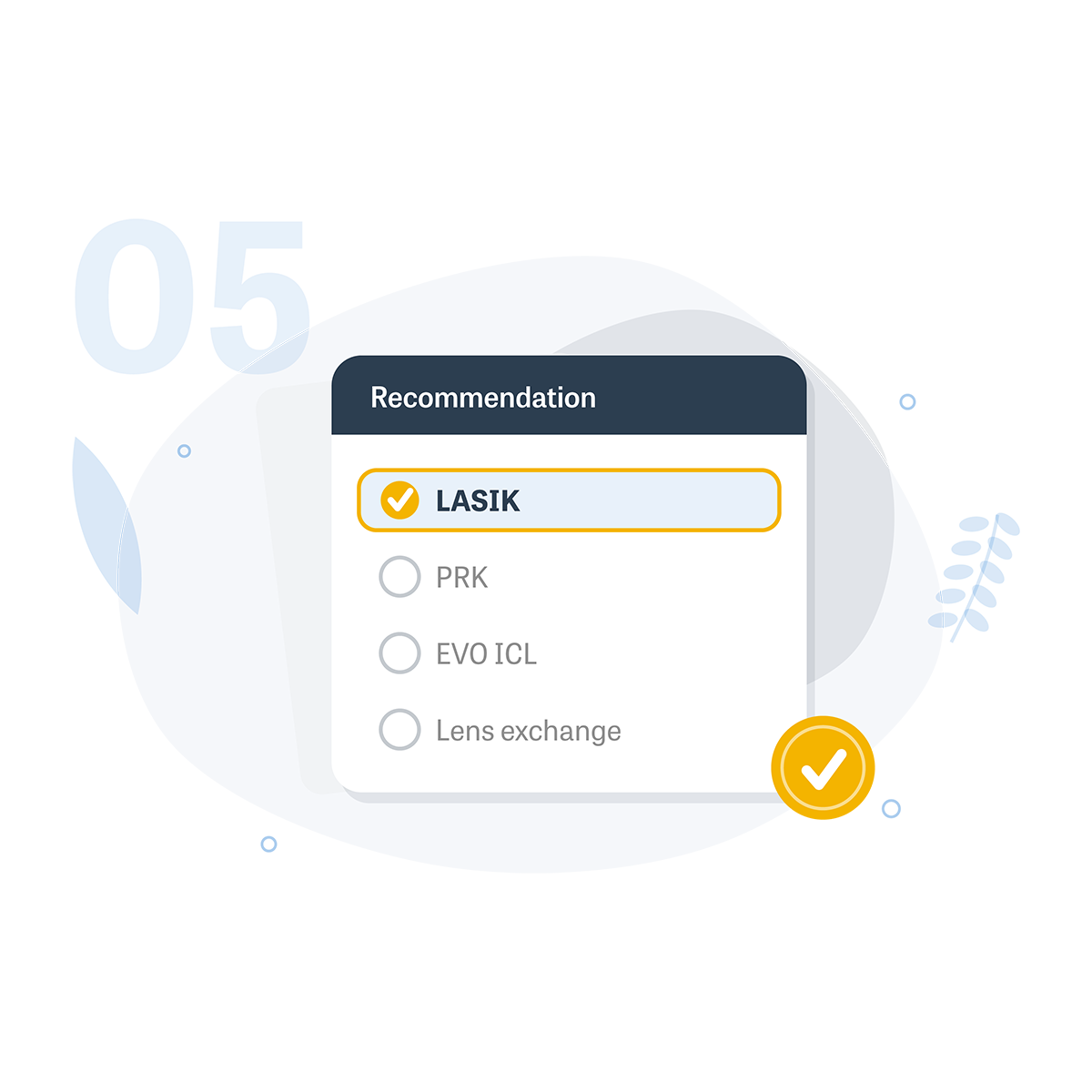
You'll get a clear answer about which procedure fits you: LASIK, PRK, EVO ICL, refractive lens exchange, or a staged combination for very high prescriptions. And if the honest answer is that surgery isn't right for you, that's the answer you'll get, with an explanation of why.

Your surgeon builds your plan
Before your procedure, your surgeon personally reviews your maps and plans your treatment at the computer, rather than handing the planning to a technician or a template. The surgeon who will perform your procedure makes every planning decision, then calls you personally before surgery day to answer any remaining questions.
Questions to Ask Any Vision Correction Surgeon
- Is the surgeon performing my procedure fellowship-trained in this area of surgery? LASIK is corneal surgery. Fewer than 1 in 5 ophthalmologists complete a cornea fellowship.
- How are my eyes prepared before diagnostic imaging? Focusing muscles that aren't fully relaxed produce distorted measurements.
- Will imaging be repeated if the first captures aren't ideal?
- Who plans my treatment, and who performs it? They should be the same person.
- Will I speak with my surgeon before surgery day?
- Who do I contact with questions after surgery, including nights and weekends?
- What happens if I'm not a good candidate? A practice that only offers LASIK can only recommend LASIK.



Nervous About Eye Surgery? That's Normal
Fear is one of the most common reasons people wait longer than they need to.
So here is what our patients tell us, almost universally, after their procedure: it was far easier than they imagined. The procedure itself takes under fifteen minutes for both eyes, and the laser treatment averages about 45 seconds per eye.
We meet you where you are, with patience, clear answers, and as much time as you need, so even if you’ve always struggled with anything near your eyes, you can feel supported at every step.
Ready When You Are
Everything you just read is standard here and is the same care our founding surgeons have brought to more than 130,000 procedures, refined over three decades by two fellowship-trained corneal specialists who spent their careers teaching this work to other surgeons.
And the care doesn't end when the evaluation does. Before surgery, your surgeon calls you personally. After it, you'll have their number.