
Told Your Prescription Is Too High for LASIK?
You may have more options than you’ve been given.
We see patients who were told elsewhere that nothing could be done: prescriptions of -10, -15, even -20 and beyond. Many of them now live without glasses or contacts. Not because the rules of surgery are different here, but because our surgeons work with a wider set of tools, and know how to combine them.

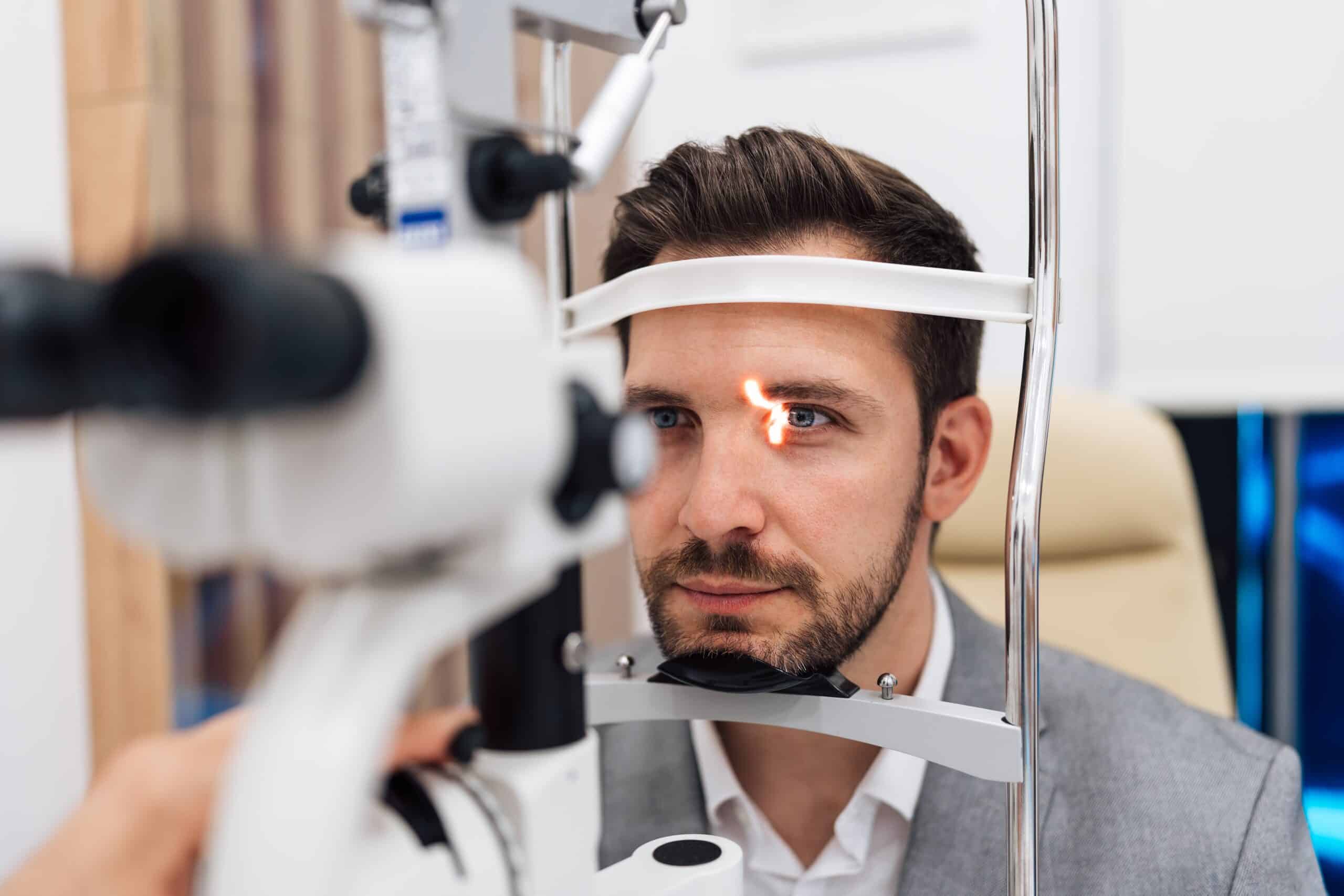
Every Option, Under One Roof
Most vision correction centers offer one or two procedures. If your prescription falls outside their range, the answer you get is no. Our practice offers the complete range, which means the question is never “do you fit the procedure?” It’s “which procedure fits you?”
Bioptics: When One Procedure Isn’t Enough
Some prescriptions are simply too high for any single procedure. A -20 or -22 prescription exceeds what the ICL alone can correct, and no responsible surgeon would attempt it with a laser alone.
Bioptics solves this by dividing the work between two procedures, each doing what it does best:
Step 1: The LASIK flap is created.
No laser treatment is performed yet. The flap is made first so it never has to be created over an implanted lens.
Step 2: The EVO ICL is implanted.
About a week later, the implantable lens corrects the majority of the prescription, up to its full range.
Step 3: The remaining prescription is treated.
About a month later, the flap is gently lifted and the laser corrects whatever prescription remains, fine-tuning the result.
Using this staged approach, our surgeons have corrected prescriptions as high as approximately -24. For many of these patients, the change is hard to overstate: people who could not read the largest letter on the chart, who could not function without thick glasses from the moment they woke up.
“You should see the smile on their faces.”
Dr. Mark Speaker
Where Doctors Send Their Difficult Cases
High prescriptions are only part of what we see. Physicians across the region refer us their most complicated patients: unusual corneas, prior surgeries that need revisiting, post-operative problems that need an experienced hand.
There’s a reason for that. Both of our founding surgeons are fellowship-trained corneal specialists. Dr. Speaker founded the Cornea Fellowship program at New York Eye and Ear Infirmary and spent 25 years training corneal surgeons, and more than 250 doctors refer their patients to each of our surgeons.
If another practice told you no, or told you your case was too complicated, we welcome you to come in for a second opinion.

If Surgery Isn’t Right for You, We’ll Tell You
A wider set of tools doesn’t mean surgery is right for everyone. Our philosophy is the same for a -2 prescription as it is for a -20: we don’t fit the patient to a procedure, we find the right procedure for the patient. And when the honest answer is that surgery isn’t in your best interest, that’s the answer you’ll get, along with an explanation of why and what your alternatives are.
Get a Clear Answer About Your Eyes
Bring us your prescription and your history, including what you’ve been told elsewhere. We’ll give you a thorough evaluation and an honest answer.
Not sure where to start?